

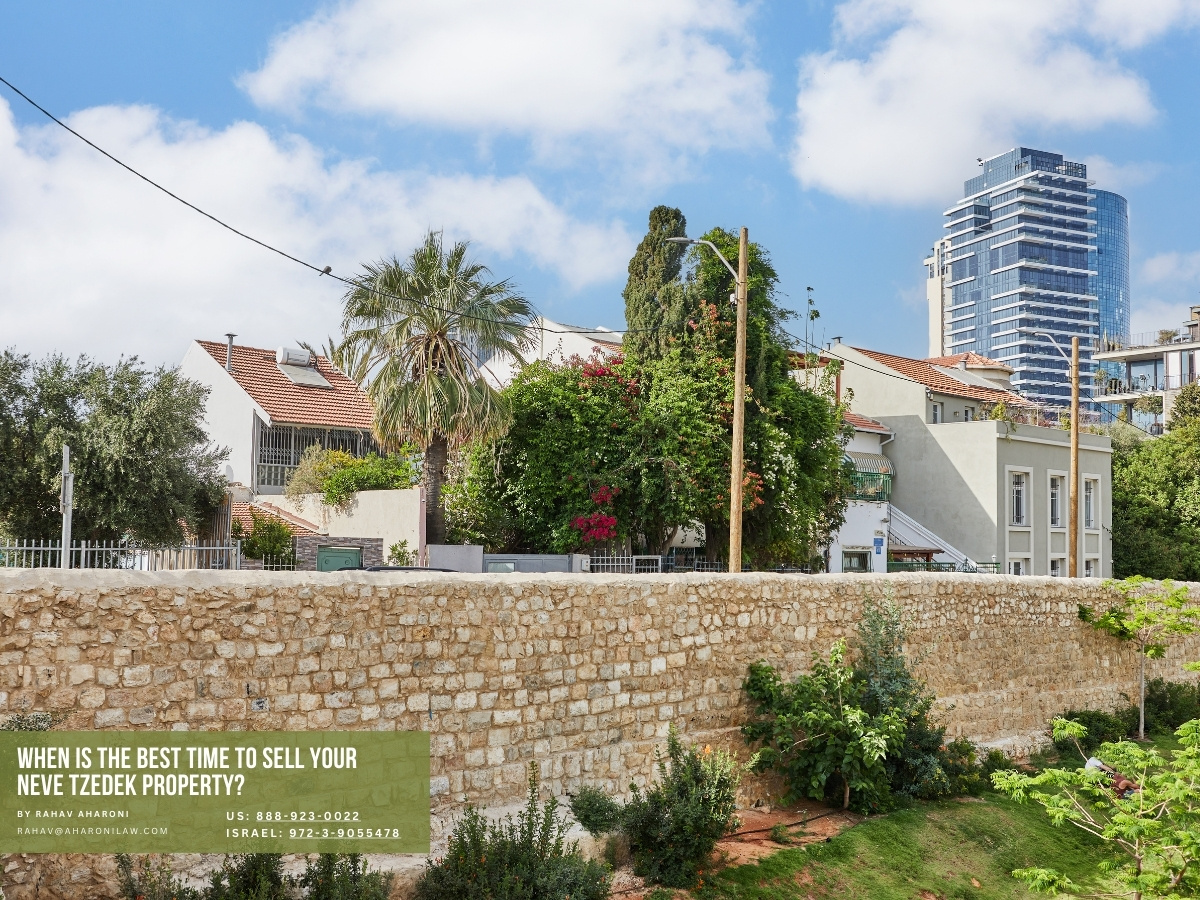
Selling a property in Tel Aviv’s coveted Neve Tzedek neighborhood is a significant decision, especially for owners living abroad. Neve Tzedek’s real estate market is unlike any other – it’s an elite, high-demand enclave where homes command some of the highest prices in Israel and often sell quickly even when broader market conditions fluctuate.
Deciding when to sell in such a unique market requires balancing general real estate trends with the specific quirks of Neve Tzedek and your personal circumstances. In this guide, we’ll explore all aspects of timing your sale for the best outcome, covering seasonal patterns, market trends as of 2026, differences between property types (houses, penthouses, apartments, garden units, land, etc.), and legal considerations.
By the end of our guidance, you’ll have a clear, actionable understanding of how to time your Neve Tzedek sale – and why working with an experienced Israeli real estate attorney can make all the difference.
Neve Tzedek’s Unique Market Dynamics
 Neve Tzedek’s preserved historic charm – from its sunny courtyards to its boutique-lined lanes – has sustained extraordinary demand for its real estate. The neighborhood stands out as one of the most desirable (and expensive) in all of Israel. Even in a city like Tel Aviv, known for high property values, Neve Tzedek achieves premium prices and faster sales than anywhere else.
For context, as of 2025, the average home price in Neve Tzedek was around ₪8.33 million (≈$2.2 million) – roughly double the Tel Aviv average of ₪4.37 million (≈$1.29 million). Properties here spent an average of just 24 days on the market, underscoring the intense buyer competition for this area. Even Tel Aviv’s other priciest district (the Rothschild/Lev Hair area) had slightly lower prices and longer selling times than Neve Tzedek, underscoring the neighborhood’s exceptional demand.
Why is Neve Tzedek so sought-after? Much comes down to its character and rarity. It’s a charming “village” in the heart of Tel Aviv, with beautifully preserved historic architecture alongside modern luxury residences. The supply of homes is inherently limited by strict preservation rules in the neighborhood’s core, and no two properties are quite alike.
Many homes are historic gems or high-end boutique buildings, which attract affluent buyers seeking something special. In fact, foreign buyers have been especially active in Tel Aviv’s luxury market – about 30% of property transactions in Tel Aviv are by foreigners (led by North Americans, French, and British), and Neve Tzedek is often the prime location on their radar. This international demand adds a constant stream of potential buyers, independent of local Israeli market cycles.
It’s important to recognize that Neve Tzedek’s prestige has historically made it more insulated from downturns. Over the past decades, even during occasional lulls in Israel’s real estate market, high-end areas like Neve Tzedek tended to hold their value (and sometimes continue rising) thanks to their scarcity and “safe haven” reputation.
For example, during recent market slowdowns, Neve Tzedek still saw headline-making deals – a historic penthouse sold for ₪50 million in mid-2025 (≈$13–14 million). That record-setting sale (at roughly ₪100,000 per square meter) proved that there will always be buyers for one-of-a-kind Neve Tzedek properties, even if overall buyer activity in Israel cools.
All these factors mean that as a Neve Tzedek owner, you start from a position of strength – your property is in a perennial “seller’s market” pocket. However, timing still matters if you want to maximize your sale price and ensure a smooth transaction. Next, we’ll look at broader market trends in 2025–2026 and how they intersect with the Neve Tzedek market.
Neve Tzedek Market Timing Factors as of 2026
Timing the sale of any property requires understanding the wider real estate climate. As we step into 2026, the Israeli housing market is in a very different phase than just a few years ago.
Here are the key market factors to consider and how they might affect the timing of your Neve Tzedek sale:
Overall Market Cycle
After a decade of frenzied growth, Israel’s housing market began to stabilize and even dip slightly in 2024–2025.
Nationwide, transaction volume slowed, and prices in many cities actually inched down in 2025. By Q2 2025, the average Israeli home price was ~2.5% lower year-on-year – the first decline in years – and when adjusted for inflation, it was the sharpest drop since 2007. This cooldown was driven by economic headwinds and an unsettled domestic climate (more on that below).
However, Tel Aviv was a notable exception to the downturn: it still posted a +5.1% annual price increase by mid-2025, the highest among Israel’s major cities. In other words, while many areas struggled, Tel Aviv (especially prime neighborhoods like Neve Tzedek) held strong or continued climbing.
What this means for you: the broader market isn’t delivering automatic double-digit gains as it did in the boom years, but Neve Tzedek property values remain robust. You likely won’t see prices plunging in Neve Tzedek, even if the national picture is flatter now.
That said, buyers today have more negotiating power than they did during the ultra-hot market of a few years ago. You can still achieve a great price – just don’t expect the kind of easy bidding wars of the past without the right strategy (more on pricing strategy later).
Economic and Interest Rate Climate
One big reason the market cooled is that interest rates rose sharply from 2022 to 2023, making mortgages more expensive and buyers more cautious.
The Bank of Israel’s benchmark rate rose to around 4.75% in 2023 (from near 0% in 2021), significantly tightening credit. High borrowing costs tend to shrink the pool of local buyers, especially for expensive properties.
The good news is that as of early 2026, this trend is finally reversing. In a surprise move, the Bank of Israel cut rates in November 2025 and again in January 2026, bringing the rate down to 4.0%. Policymakers cited easing inflation and economic stabilization after the Gaza ceasefire as reasons to begin loosening monetary policy. They even forecast the rate could drift down to ~3.5% by late 2026 if conditions allow.
Why does this matter for timing? Lower interest rates improve affordability and typically stimulate buyer demand.
As 2026 progresses, we may see more local Israeli buyers re-entering the market, able to finance purchases on better terms. If you’re targeting an Israeli buyer (for instance, a young family or investor from Tel Aviv), a period of falling interest rates could be an excellent window to list your property, because more buyers will qualify for loans and be actively hunting.
On the other hand, if you list when interest rates are at peak highs, some domestic buyers might delay purchases or expect price concessions to offset their higher financing costs. In Neve Tzedek’s luxury segment, many buyers are foreign or pay cash, so interest rates aren’t the only driver – but it still has an indirect effect on overall market sentiment.
Post-Conflict Recovery and Investor Sentiment
The past couple of years brought unusual uncertainties, including a war that began in October 2023 and extended tensions into 2024.
During the war and its immediate aftermath, one might have expected real estate to slump – but interestingly, many investors turned to property as a safe haven. Even with an oversupply of new construction in Israel by mid-2024, prices continued to rise amid the conflict because people saw Israeli real estate as a stable, tangible asset during uncertainty.
Neve Tzedek, with its historic significance and high-end appeal, fits that “safe haven” profile perfectly – affluent buyers (both Israeli and overseas) tend to hold such properties for the long term, confident that values will endure.
Now that a ceasefire and relative stability have taken hold by late 2025, the question is whether prices will drop or simply stabilize.
So far, the data show a plateau rather than a crash: Tel Aviv prices in late 2025 were up ~5% early in the year, but some segments then dipped 6–8% by year-end.
In other words, we’re seeing a small correction or leveling off, not a freefall. Many experts predict a period of stabilized prices through 2026 – essentially a market catching its breath – rather than any dramatic spike or crash.
For a Neve Tzedek seller, this means you shouldn’t feel panicked to “get out before a crash” (there’s no sign of a collapse in this area), but you also shouldn’t assume waiting a year or two will automatically yield a significantly higher price. The frenzy of 2021–2022 (when merely holding out longer could net you a higher offer) is behind us.
Now it’s a more balanced market: selling sooner or later in the next couple of years will likely be within a similar price band, unless some new factor dramatically shifts supply/demand.
Thus, your decision can focus more on personal readiness and micro-timing, rather than trying to ride an obvious up-or-down swing.
Foreign Exchange Rates
One timing consideration unique to overseas owners is currency exchange.
If you plan to convert your sale proceeds from Israeli shekels (₪) to dollars, euros, or another currency, the forex rate at the time of sale will affect how much you ultimately pocket in your home currency.
In 2023, the shekel weakened significantly amid domestic unrest and war, making Israeli property cheaper in dollar terms. But as of early 2026, the shekel has rebounded to a four-year high against the dollar. This strength is partly due to improved economic outlook post-conflict and cautious monetary policy.
A strong shekel benefits a foreign seller converting to dollars: each shekel earned translates to more USD.
For example, if you sold your property for ₪10 million when the rate was 4 ₪/$, that was $2.5 million – but at 3.5 ₪/$, the same shekel price yields ~$2.86 million. Right now, the shekel’s strength boosts your currency return (compared to late 2023 levels).
Keep an eye on this: if the shekel remains strong or even strengthens further, it’s an opportune time to repatriate funds.
Conversely, if you anticipate the shekel might weaken later (due to political events or global trends), you may prefer to sell before that happens. Of course, currency markets are hard to predict, and this shouldn’t be the sole driver of your decision – but it’s worth factoring in if exchange rates would significantly impact your plans.
Local Developments and Supply in Neve Tzedek
Another micro-timing factor is what’s happening in the neighborhood itself.
Neve Tzedek is largely a low-rise, historic area with limited new construction, which is good news for sellers – you’re not facing a flood of new competing listings. That said, there are a few high-end projects on the periphery (such as the “Merhav HaAtad” 40-story tower by Tidhar Group near the old railway park) scheduled for the coming years.
New luxury developments near Neve Tzedek have been fetching ₪70k–₪90k per square meter, on par with the priciest projects in Israel.
The introduction of a gleaming new tower or two could do two things:
- Attract more buzz and high-net-worth buyers to the area (a plus for your sale),
- Offer alternative options for those buyers (new penthouses with sea views, etc.), which could be competition.
If your property is a historic house or unique character apartment, you’re playing in a different niche than a modern tower apartment – many buyers specifically want Neve Tzedek’s quaint charm that new high-rises can’t offer. Still, it’s wise to be aware of the timing of any major project launches.
For instance, if a new luxury building is about to start marketing apartments next door, you might want to list before those hit the market (to avoid splitting buyer attention) or wait until they’re nearly sold out (so your sale can piggyback on heightened area interest but not compete directly).
An experienced local attorney at our firm will be up to date on these developments and can advise.
Additionally, improvements like the Tel Aviv light rail and upcoming metro lines will soon boost accessibility near Neve Tzedek. As stations become operational (expected by 2027 for new lines), areas near transit typically see value appreciation.
If your property is within easy reach of a planned station, keep that in mind – values may tick up as completion nears, which could favor waiting to sell until those benefits are clearer.
On the flip side, prolonged construction works can be a temporary nuisance (noise, road closures), which some sellers prefer to avoid by selling beforehand.
In short, hyper-local timing (neighborhood improvements, construction, zoning changes) can create minor ebbs and flows in Neve Tzedek property appeal. It’s worth consulting with your attorney about any known municipal plans that could influence buyer sentiment in the next year or two.
Conclusion: The 2026 market outlook for Neve Tzedek is cautiously optimistic. The neighborhood still commands top-tier prices and attracts motivated buyers, but we’re in a period of normalization where careful strategy is needed to get the best price. Next, we’ll delve into how seasonality and the time of year can affect your sales prospects, followed by how the type of property you own plays a role in timing.
Timing Your Neve Tzedek Property Sale by Time of Year
Real estate activity in Israel (and Tel Aviv in particular) tends to ebb and flow with the seasons and holiday calendar. While Neve Tzedek’s allure is not especially seasonal – there are interested buyers year-round – you can get an edge by aligning your listing with peak periods of buyer presence.
Here’s a breakdown of seasonal trends and how they might influence the best time of year to put your Neve Tzedek property on the market:
Spring and Early Summer (March through August)
This is usually the busiest real estate season in Israel. The weather is pleasant, and it coincides with major travel and holiday periods. Many overseas Jewish buyers or visitors come to Israel during Passover (usually April) and again in the summer months.
Likewise, local families prefer to move during the summer school break to minimize disruption for their children. In Jerusalem, an analysis showed the market reaching its peak activity from March to August for exactly these reasons – and a similar dynamic applies in Tel Aviv’s desirable neighborhoods.
In Neve Tzedek, listing in spring can be advantageous because you capture the wave of international buyers during Passover and the general upswing in buyer momentum in April/May. You also position the sale to potentially close by late summer, which suits families aiming to relocate before the new school year.
During these months, foot traffic and buyer inquiries are at their highest, and well-priced properties can spark bidding wars in a strong year. Be aware, though, that many other sellers also choose spring to list (given the higher foot traffic), so there’s more market inventory then.
The good news is that Neve Tzedek homes tend to stand out – the neighborhood’s reputation alone draws attention. Sellers here often find that in springthey can achieve full price or above, particularly if multiple foreign buyers fall in love with the property during holiday visits.
Just be prepared for knowledgeable buyers: many will have seen a few alternatives, and they will be comparing value closely.
To leverage the spring/summer peak, ensure your pricing is compelling relative to other options; this can create a sense of urgency and possibly prompt a competitive offer.
Also, aim to have your home looking its best by March (maybe complete any minor renovations or touch-ups over the winter) so it’s photo-ready and “show-ready” for the peak season.
Fall (September through November)
The early fall in Israel is dominated by the High Holidays period – roughly mid-September to mid-October (covering Rosh Hashanah, Yom Kippur, Sukkot, and related festivals).
During these weeks, the market temporarily slows down: many locals go on vacation or are busy with family gatherings, and international travel to Israel spikes, though it’s more about holiday celebrations than house-hunting.
If you list right before or during this holiday season, don’t be surprised if things are quiet – showings may be hard to schedule, and some buyers will wait until after the holidays to get serious.
However, immediately after Sukkot (which ends in early October), there is often a renewed urgency. Sellers who postponed listing in the holiday month will come online, and buyers who spent the holidays considering their plans often jump back into the market by late October.
There’s also a practical aspect: some sellers want to close deals by the end of the calendar year (for tax or relocation reasons), so Q4 can see motivated sellers and buyers interacting.
For a Neve Tzedek seller, the post-holiday autumn period can actually be a sweet spot. The frenzy of summer is past, so only serious buyers are looking – you’ll get fewer tire-kickers and more qualified prospects.
There are also fewer competing listings in Oct/Nov than in spring, since many sellers either succeeded in summer or decided to wait for next spring. This means your property, especially if it’s unique, could garner more attention per listing.
Additionally, foreign buyers from Europe or the U.S. sometimes take advantage of pleasant fall weather and less touristy timing to come property-hunting in Israel. To make the most of an autumn sale, consider listing right after the holidays (say, early/mid October) when the market wakes up.
Ensure your pricing is realistic – after a slower summer or a plateauing market, buyers in the fall are looking for value and may have an eye on year-end bargains.
However, don’t mistake the slight seasonal lull for a buyer’s market – in Neve Tzedek, a well-priced home in October can still sell quickly at a premium. The key is to capture those buyers who are keen to make a decision before year-end, often to settle in by winter or position themselves before the next big wave of competition arrives in spring.
Winter (December through February)
Traditionally, winter is the quietest season in Israeli real estate. The weather (though mild in Tel Aviv compared to Europe/North America) turns rainier and cooler, daylight hours are shorter, and there are fewer natural points of urgency for buyers.
Many people are busy with end-of-year holidays or, in the case of international prospects, occupied with holidays like Christmas/New Year’s back home. This season sees fewer transactions overall – both buyers and sellers catch their breath. But “quiet” doesn’t mean “dead.” In fact, winter can be a surprisingly strategic time to sell if you have a highly desirable property and want it to be the star of the show.
Here’s why: serious buyers do exist in winter, and those looking during the off-season are often highly motivated (they might be relocating for a job or have cash and be hunting for an opportunity).
Crucially, they face very little competition – there are fewer bidding wars, and sellers who list in winter are often serious about making a deal. From a seller’s perspective, if you list in say January, you might get fewer viewers overall, but anyone who comes through that door is likely a genuine buyer, not a browser. And because there aren’t dozens of other Neve Tzedek homes on the market, you have a better chance of capturing whatever demand is out there.
Negotiations in winter may tilt in buyers’ favor generally (they know you don’t have as many offers coming in), but in Neve Tzedek’s case, if yours is the only authentic Bauhaus townhouse (for example) available at that time, a buyer can’t afford to be too aggressive, or they’ll lose the one rare option.
One tactical consideration: if you do list in winter, make sure to highlight how attractive and turnkey your property is.
Use good lighting in photos and staging to compensate for the season’s gloom. Also, leverage the fact that by selling in winter, you’ll beat the rush – a sale agreed in Jan/Feb will close by spring, possibly at a better price than waiting until everyone lists in April.
Winter sales can succeed in Neve Tzedek, especially for unique or high-end properties, but expect a bit more patience and be ready to negotiate with a smaller pool of buyers. If you’re not in a rush, some sellers take their home off-market during the deepest winter months and prepare for a spring launch instead. This can be wise if your home requires work or if the particular winter is unusually slow (for instance, in early 2025, the market was slower due to the then-ongoing conflict).
On the other hand, if you receive an attractive offer in winter, there’s little sense in waiting – as long as it meets your goals, a bird in hand is worth two in the bush.
Bottom line, the best season to sell in Neve Tzedek depends on your priorities.
If you want maximum exposure and the potential of multiple competing buyers, spring to early summer is the prime window. If you prefer to sell when serious buyers have fewer choices (and you’re willing to price competitively), late fall or winter can work in your favor.
Neve Tzedek doesn’t suffer the drastic seasonal price swings some markets do – a heritage home in Neve Tzedek could fetch a premium in November or March alike – but timing your sale to when your target buyers are most active will smooth the process.
An experienced attorney can advise if, for example, many French buyers (who often vacation in August) are coming to town, or if it might be wise to list before a known seasonal slowdown. By being mindful of these rhythms, you can avoid having your listing “sit” unnoticed and instead hit the market when it’s most likely to shine.
Tailoring Timing to Your Property Type in Neve Tzedek, Tel Aviv
Another critical aspect of “when is the best time to sell” is the type of property you own. Neve Tzedek’s real estate is wonderfully diverse – you might be selling a 19th-century historic house, a modern luxury penthouse, a cozy garden apartment, or even a vacant plot of land. Each property type has its own ideal timing considerations, as buyer profiles differ.
Let’s break down the major types of properties in Neve Tzedek and what timing factors to think about for each:
Historic Houses & Unique Villas
Owning a standalone house or a historic townhouse in Neve Tzedek puts you in possession of pure gold in terms of rarity.
Buyers for these properties are often affluent connoisseurs – families with deep roots, overseas buyers seeking a trophy home, or boutique developers looking to restore a gem. The sale of a one-of-a-kind historic home is less about seasonality and more about finding the right buyer.
Such buyers can appear at any time, and when they do, they tend to act decisively (because these houses rarely come up for sale). Therefore, the “best time” to sell a unique house is when you’re fully ready, and your house is fully ready.
Make sure all your historical documentation and any necessary preservation approvals are in order before listing, as sophisticated buyers will do thorough due diligence. It can help to time the listing to high-visibility periods (e.g., just before a major holiday season or during a high-profile local event) to maximize exposure to high-net-worth visitors. But don’t be surprised if the eventual buyer wasn’t even actively looking – often these homes trade hands because someone falls in love on a visit.
Work with your attorney to discreetly market to known potential buyers (our firm often knows clients specifically seeking Neve Tzedek houses) and be prepared for a potentially longer lead time to find that perfect match.
The good news: given Neve Tzedek’s enduring prestige, there is almost never a “bad” time to sell a historic home here – any month, any year, someone could be waiting for exactly what you have.
Luxury Penthouses & High-End Condos
Neve Tzedek has seen a bloom of luxury apartments and penthouses, whether in restored buildings or in new projects at the neighborhood’s edge.
These properties, often priced in the many millions of dollars, have a more limited buyer pool. High-net-worth individuals (local tech/finance professionals or international buyers) are your target demographic.
Timing for luxury units can hinge on broader economic confidence. For instance, if stock markets are soaring or if a major IPO minted new millionaires in Tel Aviv, that’s a great time to list a NIS 20M penthouse – liquidity is high, and luxury buyers feel bullish. Conversely, if there’s a global financial scare or local tech downturn, luxury sales can slow as wealthy buyers become more cautious.
As of 2026, with the market stabilizing, luxury segments have seen slightly longer selling times – some penthouses that once sold in weeks might now take a few months as buyers weigh options. It’s not that demand evaporated; it’s that buyers at the top end are more price-sensitive and have more choices (including luxury options in other cities globally).
For your timing, consider listing a penthouse after a period of positive news – e.g., after interest rates drop or after a strong quarter for the stock market – when optimism among affluent buyers is higher. Also, try to align with times when foreign luxury buyers are around (Art Basel in Tel Aviv, if such events occur, or summer cultural festivals, etc., which attract the jet set).
Patience and pricing are key: an overpriced luxury listing can linger for 90+ days and start to lose its allure.
Buyers today are very savvy and will not bite if they feel a price is out of line with the market. It may be better to list at a compelling price to generate a swift offer than to aim unrealistically high and have the property sit unsold into the next season.
Remember, at the ultra-high end, timing the sale also means being ready to wait for that right offer – but with our guidance, we aim to shorten the wait by tapping into our network of luxury buyers and pitching the property’s unique value.
Standard Apartments & Garden Apartments
Many Neve Tzedek properties are portions of subdivided historic buildings or newer low-rise developments – think 2-3 bedroom flats, sometimes with small gardens or rooftop terraces.
These appeal to a mix of buyers:
- Young professionals,
- Expats,
- Downsizing retirees,
- Small families.
For these more “standard” units (keeping in mind Neve Tzedek’s “standard” is still special), classic real estate wisdom applies. Spring and summer might fetch the highest price because that’s when the most buyers are searching, as discussed earlier.
If your apartment would suit a family with one child, for example, listing in late spring to catch those who want to move over summer is smart. If it’s a one-bedroom perfect for a single professional or a pied-à-terre, those buyers are less bound by school calendars and more by an investment mindset or personal readiness – they’ll purchase whenever a great unit comes up.
One strategy: monitor the inventory. If you notice that there are currently five similar 2-bedroom Neve Tzedek apartments listed, it might be worth waiting until a couple sells before adding yours to avoid getting lost in the crowd.
On the other hand, if there’s nothing comparable available right now, that’s a green light to list immediately and capitalize on pent-up demand.
Also consider your apartment’s specific strengths: does it have a lovely garden patio that looks best in spring bloom? Or perhaps a cozy interior that looks good in winter? Stage and photograph accordingly, and try to list when its features shine.
Garden apartments, for instance, photograph beautifully in late winter/early spring when citrus trees and bougainvillea start adding color – a buyer seeing a sunny, flower-lined courtyard in March might emotionally connect more than seeing a bare one in December.
Ultimately, for these properties, any time of year can work as long as you’re cognizant of competition and present the home well. From a pricing/timing synergy perspective, note that currently (early 2026), buyers of these units have more choice and are price-conscious, since the frenzy has cooled.
So, a fresh, reasonably priced listing will perform well – whereas an old listing that’s been sitting (perhaps because it started overpriced) can become stale. If you’ve had your apartment on the market without success, sometimes temporarily withdrawing and re-listing in a different season with a new pricing strategy can reset the clock and attract renewed interest.
Plots of Land or Redevelopment Properties
It’s rare, but some owners hold undeveloped land or old buildings intended for teardown/redevelopment in or around Neve Tzedek.
These sales are a different animal. Your buyer is likely a developer or an investor looking at the potential, not an end-user dreaming of living there next month. The best time to sell land often hinges on planning and policy moments.
For instance, if the city has just approved new building rights or upzoning in the area, your land value might jump – selling after such an approval (or getting the approval yourself before selling) can maximize price. Conversely, if there’s uncertainty about what can be built (perhaps awaiting a decision on a conservation status or a zoning plan like TA/5000 updates), buyers will be cautious; it might pay to wait for clarity (which our firm can often help expedite or at least assess) so you sell into a confident market.
Additionally, developers’ appetite is tied to the economy and credit conditions: when interest rates are low and financing is cheap, developers aggressively seek land. When credit is tight and the market is soft, they pull back.
With rates now starting to decline in 2026 and some stability returning, developer interest in prime Tel Aviv land is picking up again. Keep an eye on government moves too – any changes to land taxes or initiatives to encourage housing starts could influence demand.
One tactical note: If you have a small parcel that might be worth more when assembled with a neighbor’s parcel for a bigger project, consider whether collaborating or waiting for that opportunity is worthwhile.
Timing the sale of land may involve less seasonal sway (developers work year-round) and more strategic timing of market cycles and regulatory milestones.
As your Israeli attorney, we can value-engineer this: we’ll look at any existing plans, permits, or historical designation on the property and advise if you might get a significantly higher price by, say, securing a building permit first or selling at a time of low construction costs for developers.
Selling land in Neve Tzedek is ultimately about selling future potential, and the best time is when that future looks brightest and most feasible to buyers.
In all cases, whether you have residential or commercial property, an experienced real estate attorney can help analyze both macro conditions and micro timing for your specific asset.
We often prepare a strategy with our clients that might sound like: “If we list your penthouse in May at X price, we anticipate Y; if it doesn’t sell by August, consider renting it out until next spring rather than reducing price in a weak fall market,” or “Let’s quietly offer your historic home to a short list of buyers now, and if none bite by summer, we’ll go public during the peak season with a full marketing blast.”
By tailoring the approach to the property and being proactive rather than reactive, you set yourself up for success.
Legal and Logistical Considerations in Timing
Clients often ask us not just when they should sell, but how long the selling process will take – and this ties directly into timing your sale. When planning the best time to start the sale, you should also factor in the timeline to complete the transaction and receive your proceeds.
Here are some key legal/logistical timing points to keep in mind:
Preparing Your Paperwork (Start Early)
Before you even list your property, ensure all your legal documents are in order. If you are an overseas owner who inherited the property, the title must be transferred to your name via an Israeli probate before you can sell. This is a crucial step – if you haven’t done it yet, start ASAP.
Our firm routinely handles Israeli probate for foreign clients and can often obtain the court order within a few months or even weeks in uncontested cases.
Similarly, check that your Tabu (Land Registry) deed accurately reflects your ownership and that there are no surprises (such as liens, mortgages, or rights of first refusal) recorded on the property.
Discovering and resolving any such issues before a buyer is involved will save you time and preserve your negotiating strength. It’s wise to engage an attorney early to conduct a legal audit of the property – we review the title, the zoning, any condo association documents, etc., to foresee what a buyer’s lawyer might question. For example, if your property was a subdivided house, is there a registered “house committee” (HOA), and is everything formally divided or just by agreement?
These can be resolved or clarified upfront. Starting this prep a few months before you intend to list is ideal. Think of it like staging your home, but on paper: a clean legal file makes the sale process much smoother and faster once you find a buyer.
Transaction Timeline in Israel
Once you do find a buyer and accept an offer, how long until closing? Israeli real estate transactions usually involve a contract signing (exchange) first, followed by completion a few months later.
After agreeing on terms, the parties (through their lawyers) will negotiate and sign a detailed Sale Agreement within a couple of weeks. When that contract is signed, the buyer usually pays a down payment (often 10–20%). From that point, it often takes 2–3 months (or more) for the buyer to arrange their remaining funds, mortgage, and for all conditions to be met before final closing.
In the contract, we set a completion date, but note that in Israel, it’s common to allow some flexibility or extensions if agreed (for instance, if a buyer’s mortgage is delayed slightly). During this interim period, your lawyer (us) will be busy obtaining necessary certificates, such as the Israel Tax Authority’s “Seller’s Tax Clearance Certificate” confirming capital gains tax is settled.
By law, the sale must be reported to the tax authority within 30 days of contract signing, and either the tax paid or an exemption claimed. We handle this on your behalf, calculating your Capital Gains Tax (Mas Shevach) and filing the report promptly. The buyer’s lawyer will usually hold some money in escrow until this tax clearance is obtained, which is standard practice.
We make it a priority to obtain the clearance quickly – we know you want your full funds without undue delay. In parallel, if you had a mortgage on the property, we will ensure it’s discharged.
By completion day, all these pieces should come together: the buyer pays the remaining balance, you hand over keys (or vacate by an agreed date), and we transfer the title to the buyer.
As a foreign seller, you do not need to be physically present for any of this – we will likely handle everything through a Power of Attorney that you sign abroad at an Israeli consulate or notarized. From listing to closing, therefore, think in terms of several months. If you list today and get an offer next month, add ~3 more months to closing – so perhaps 4 months total. It could be faster if a cash buyer with no contingencies appears, or slower if negotiations drag or buyer financing is slow.
Plan accordingly: If you have a target date for receiving the proceeds (maybe you’re buying something else or moving funds), count backward and start the sale well in advance.
Conversely, if you know you can’t close before a certain date (e.g., a tenant’s lease ends in six months), you can still list now but negotiate a longer closing or lease-back. We often structure deals to accommodate sellers’ timing needs, such as allowing the seller to stay in the property for a few months after closing if needed (with appropriate safeguards).
Tax Timing Considerations
From a tax perspective, Israel doesn’t have an annual capital gains tax deadline like the U.S. (where selling by Dec 31 vs Jan 1 could change which tax year applies). The capital gains tax on Israeli real estate is transaction-based.
One timing factor: if you have expenses to offset the gain (like renovation or purchase costs), gather those receipts before we file the tax report, as they can reduce your taxable gain.
If you are eligible for any partial exemption or reduced rate, we’ll advise on that. Notably, foreign owners generally do pay Mas Shevach (unlike Israeli residents, who might be exempt for a primary residence), but a 2014 reform grants a tapered exemption for long-term holdings prior to 2014.
We will calculate all this to legally minimize your tax; our firm has expertise in applying deductions and credits that can dramatically reduce your effective capital gains tax. For instance, inflation indexing of the cost, or claiming depreciation that wasn’t deducted by anyone, etc.
There’s no specific time of year when the tax rate changes; however, being aware of upcoming tax law changes is smart. If (hypothetically) Israel were planning to increase real estate taxes next year, that would be a good reason to sell now. Or if a temporary tax relief for foreign sellers were announced, that could be a reason to wait.
Currently, there is no indication of an imminent tax hike on sellers – the major change was a purchase tax hike on investors (which affects buyers more than you).
One more consideration: if you are also a U.S. taxpayer or subject to another country’s taxes, you might consult with your accountant about the best timing in your home country’s tax year to realize a capital gain.
Our role on the Israeli side is to coordinate so you get all the necessary documents for foreign tax credit purposes after the sale.
Tenant or Occupancy Considerations
If your Neve Tzedek property is currently rented, timing the sale may be affected by the lease schedule. Selling with a tenant in place can be either a pro or a con. Some investors are happy to buy and keep the tenant (especially if it’s a high rent), but many private buyers prefer to move in themselves.
Usually, having the property vacant and nicely staged will attract the broadest range of buyers and possibly a higher price. Therefore, consider timing your sale to coincide with the end of a lease.
For example, if your tenant’s lease runs till August, the best time to list might be a couple of months before that (with disclosure that occupancy is available from September). That way, you capture spring buyers while still promising a move-in after lease expiry.
We can also advise on legally terminating or not renewing a lease, if needed – always do so in accordance with Israeli tenancy law and the contract terms to avoid issues. Starting a sale process while a tenant is in place requires coordination (for showings, etc.), and we can help communicate with tenants to ensure cooperation.
In sum, align the sale with a natural vacancy if possible, or target selling to another landlord if the tenant is mid-lease. Never evict improperly just to sell; we’ll guide you through the correct procedure if eviction or lease non-renewal is needed.
International Logistics
As an Israeli real estate attorney serving many overseas clients, we make the selling process as turnkey as possible. Timing considerations here include scheduling any required signatures or notarizations.
For instance, to grant us Power of Attorney, you may need an appointment at your nearest Israeli consulate or with a notary who can issue an apostille – factor in a week or two for that.
If you plan to visit Israel at some point, sometimes clients prefer to sign documents in person while visiting and meet the team – that can be a good time to kick off the sale or finalize paperwork. But it’s absolutely not mandatory; we’ve handled countless property sales remotely via email, phone, and courier.
Another timing tip: international banking. Think about how and when you want to receive the funds from the sale. We will coordinate the transfer of sale proceeds to your foreign bank account. Israeli banks may require some documentation (like proof of the source of funds – which is the sale contract – to allow large transfers out).
We handle those compliance steps, but be aware that moving, say, millions of shekels to a U.S. or European account can take a few days of processing. If currency rates are a concern, you might instruct us to wire immediately upon closing or to hold in escrow briefly if you want to watch the rates – we can be flexible.
The main point is: communicate your timing needs to your attorney.
If you know you absolutely must close by a certain date (perhaps because you’re purchasing another property abroad and need the cash), tell us early. We will then prioritize that in negotiations – maybe choosing one buyer over another because they can close faster, or writing a penalty for delays into the contract. If you prefer a longer closing for tax or personal reasons, we’ll negotiate that.
When we represent you, your timeline is ours, and we aim to align the entire process with your life.
Why the Right Timing Strategy Matters and How Our Israeli Law Firm Can Help
We’ve covered a lot of ground – from market cycles and seasonality to property types and legal timelines – and you might be thinking, “This is complex!” The truth is, selling a Neve Tzedek property at the best possible time and terms does involve a sophisticated strategy. It’s not just about sticking a “For Sale” sign up and waiting.
But the good news is, you don’t have to navigate any of this alone. Our firm’s role is not only to handle the legal paperwork, but also to serve as your trusted advisor in the sales process, ensuring you make informed decisions at every step.
As an Israeli lawyer specializing in real estate for clients around the world, we have the experience, data, and insight to pinpoint the optimal timing for your sale. We stay on top of market trends (both national and hyper-local in Tel Aviv) and understand the regulatory environment.
We have helped clients sell properties in booming markets and in slow markets, in peak season and off-season. In every case, our guiding principle is: what serves the client’s best interest.
Sometimes that means advising you to list immediately and seize a great market window; other times, it might mean holding off for a few months (for example, until that new light rail station is officially inaugurated or until election uncertainty clears) to get a better price. We’ll give you a frank assessment – backed by evidence – so you can weigh the pros and cons.
Furthermore, with hundreds of successful real estate transactions under our belt, we know how to execute quickly when timing is critical. If an interested buyer appears, we move fast to negotiate and close the deal on your preferred timeline, without cutting corners on legal protection.
Our team has encountered and resolved myriad issues that can cause delays – from missing land registry files to last-minute buyer financing hiccups – and we use that experience to anticipate and preempt problems, keeping your sale on schedule.
Finally, one aspect of timing that’s often underestimated is the emotional timing: when do you feel ready to sell?
This is your property, perhaps a family asset or an investment you’ve held for years. Maybe you’ve been on the fence about selling, or you worry about the complexities.
A big part of our job is to give you confidence and peace of mind. We explain the process clearly, keep you updated at every stage (you’ll never be left guessing what’s happening or what comes next), and we are available 24/7 across time zones – meaning you can reach us whenever you have a question or concern.
Many of our overseas clients start out anxious about selling from afar, but end up saying the process was “easier than we ever imagined” because we handled everything and kept it transparent and efficient for them.
We are proud to be trusted by hundreds of clients as their go-to Israeli real estate counsel, and we cherish that reputation.
Choosing the right time to sell is both an art and a science. By analyzing market signals and aligning them with your personal goals, we craft a timing strategy that aims to maximize your sale price and minimize your stress.
And when you have a seasoned Israeli real estate attorney by your side, you can act with confidence, knowing that no matter when you choose to sell, all the legal and procedural details will be expertly managed.
Ready to Sell Your Property in Tel Aviv? We’re Here to Help
Selling your Neve Tzedek property is a major milestone – but it doesn’t have to be daunting or complicated. The key is to plan ahead, time it right, and have the right professionals supporting you. In this article, we’ve explored how factors like the 2026 market conditions, the season of the year, and the nature of your property all contribute to finding “the best time” to sell.
Ultimately, the best time to sell is when you are ready – ready to accept the current market value and when your personal circumstances align with a sale.
With the market plateauing (but stable) and Neve Tzedek values holding strong, 2026 presents a favorable window for well-prepared sellers to achieve excellent results.
Our firm is here to make sure your sale is a success from start to finish. From the moment you reach out for a consultation, we’ll provide you with candid advice and a roadmap tailored to your situation. We’ll help you determine an optimal listing time (and a smart pricing strategy to go with it) based on data and experience – not guesswork.
When you choose us as your legal representatives, you’re not just getting a paper-pusher; you’re getting a dedicated partner and advocate.
We handle everything: coordinating with real estate agents (or even helping you find a trustworthy English-speaking agent if you need one), preparing and reviewing all documents, negotiating offers to get you the best terms, and safeguarding your interests through to closing.
All the while, we keep you fully informed and in control, so you can make decisions confidently.
Our team, led by Rahav D. Aharoni, Adv., has deep roots in the Israeli real estate field and extensive experience working with international clients. We pride ourselves on being responsive, reliable, and results-driven – qualities our clients repeatedly highlight in their testimonials.
“Trustworthy,” “clear communicator,” “made my life a whole lot easier,” are just a few ways clients have described working with us (to quote a couple of examples).

We know that as someone abroad, you need a firm that you can trust absolutely to handle your property transaction as if it were our own. That’s exactly what we do.
We operate with complete transparency and integrity, and we treat every client’s case with personal care. It’s no coincidence that Aharoni Law Firm is one of the top-referred Israeli legal firms for real estate and inheritance matters – we’ve earned that trust by consistently delivering excellence.
So, if you’re considering selling your Neve Tzedek property, let’s have a conversation. We offer a free initial consultation, and you can reach us 24/7 at our international contact numbers or via email. We’ll listen to your goals, answer any questions you have, and give you an honest assessment of the market and how we can assist. Even if you’re not 100% sure about selling yet, getting expert input early can help you make the right decision when the time comes.
Our goal is simple: to help you achieve the most profitable, smooth, and stress-free sale possible, while safeguarding your legal rights at every step.
Timing is important – with our guidance, you’ll know when it’s right and be fully prepared to act. Now that you’re equipped with knowledge about the process and market, you’re already ahead of the game. Whenever you decide to take the next step, rest assured that you can rely on our firm’s experience, expertise, and unwavering commitment to your success.
Contact an Experienced Israeli Real Estate Attorney at Our Firm
Contact us today to start the conversation. We look forward to being your trusted partner in selling your Neve Tzedek property and to adding your story to our long list of successful client outcomes. Your property is extraordinary – and with the right timing and the right attorney at our firm by your side, your sale can be extraordinary too.
Let’s make it happen!
